- Financial Planning
The Real Cost of Affordable Nursing Homes — and What Families Can Do About It
Finding affordable nursing homes for a parent is one of the hardest financial challenges a family can face. Here is a quick overview of your most practical options:
Quickest paths to affordable senior care:
- Medicaid-certified nursing homes — Medicaid covers 100% of costs for qualifying residents and funded 63% of all nursing home residents in 2024
- Assisted living — Median cost is $5,419/month, significantly less than the $9,277–$10,646/month median for nursing home rooms
- HUD Section 202 housing — Government-subsidized senior housing where rent is capped at roughly 30% of income
- VA Aid and Attendance — Tax-free benefit for eligible veterans and surviving spouses to offset care costs
- Residential care homes — Smaller, home-like settings that often cost less than traditional nursing facilities
The numbers are stark. Nursing home care can run anywhere from $4,258 to over $23,000 per month, yet the average Social Security retirement check in 2026 is just $2,071. Nearly 1 in 10 Americans over 65 lives in poverty. For millions of families, that gap is not just stressful — it feels impossible.
The good news is that the gap can be bridged. There are real programs, legal strategies, and lower-cost care settings that make quality senior care reachable — if you know where to look.
This guide walks you through all of it clearly and honestly.
I’m Phillip King, a senior living executive with decades of hands-on experience across independent living, assisted living, memory care, and skilled nursing — including helping families navigate the true cost of affordable nursing homes across multiple market cycles. In the sections ahead, I’ll break down every major option so you can make a confident, informed decision for your family.
Affordable nursing homes vocab explained:
Understanding Senior Care Options and Cost Differences
When we begin looking for care, the terminology alone can make our heads spin. Many families use the terms “nursing home” and “assisted living” interchangeably, but they represent entirely different levels of clinical support, lifestyle, and pricing. Knowing the difference is the first step toward saving thousands of dollars a year.
Let’s look at how these options stack up side-by-side in terms of daily support, medical oversight, and monthly cost:
| Care Type | Primary Focus | Medical Care Level | Average Cost Range (Monthly) |
|---|---|---|---|
| Assisted Living | Help with daily activities, social life, & independence | Intermediate (medication management, minor assistance) | $3,500 – $6,000+ (Median: $5,419) |
| Skilled Nursing (Nursing Home) | 24/7 medical supervision & clinical therapy | High (registered nurses on-site, complex medical needs) | $4,258 – $23,451 (Median: $9,277+) |
| Residential Care Homes | Small, home-like shared environments | Low to Intermediate (personal care, meals, utilities) | $2,000 – $5,000 |
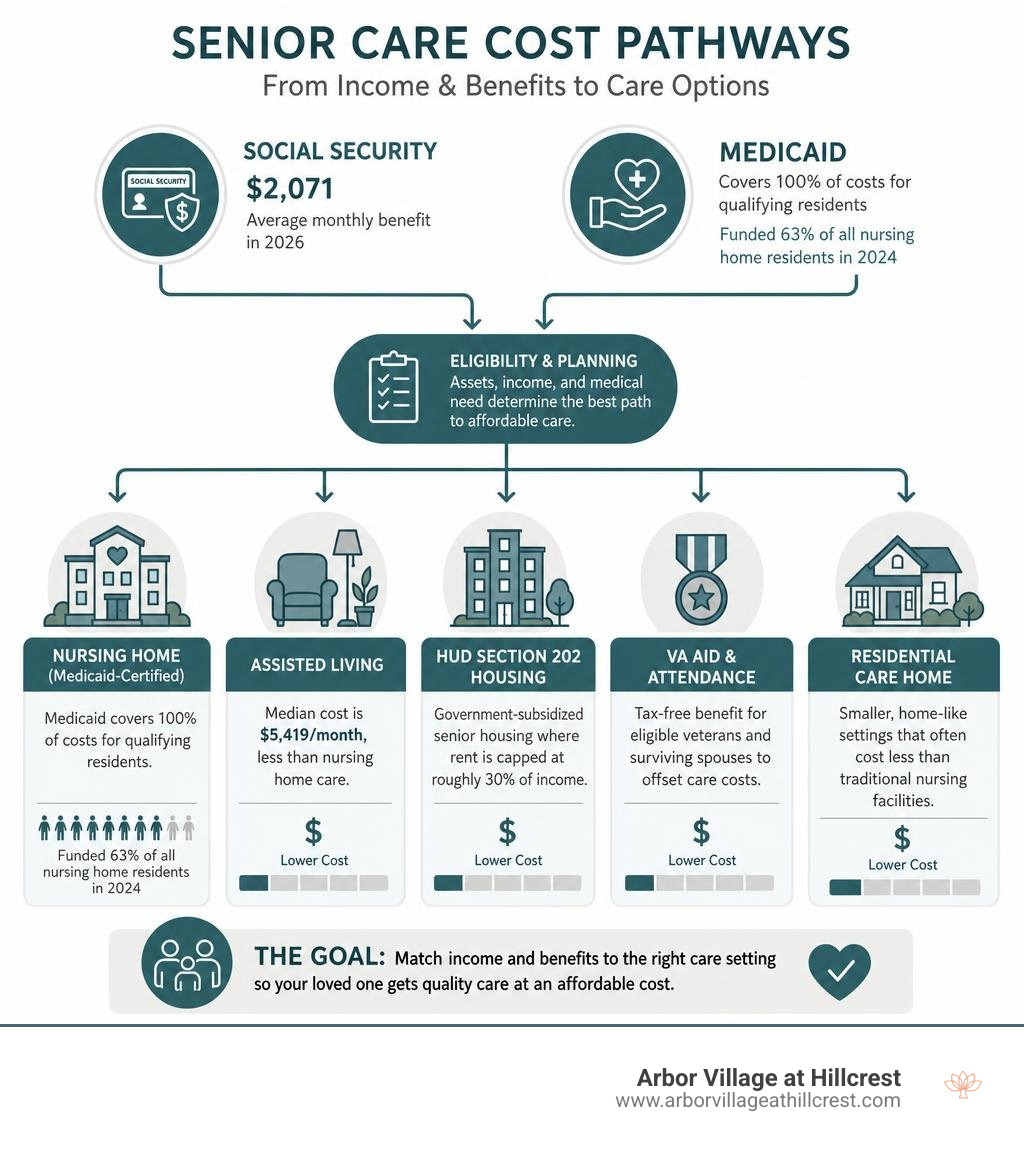
To help visualize how these care pathways diverge based on a senior’s physical needs and budget, let’s look at the decision-making process:
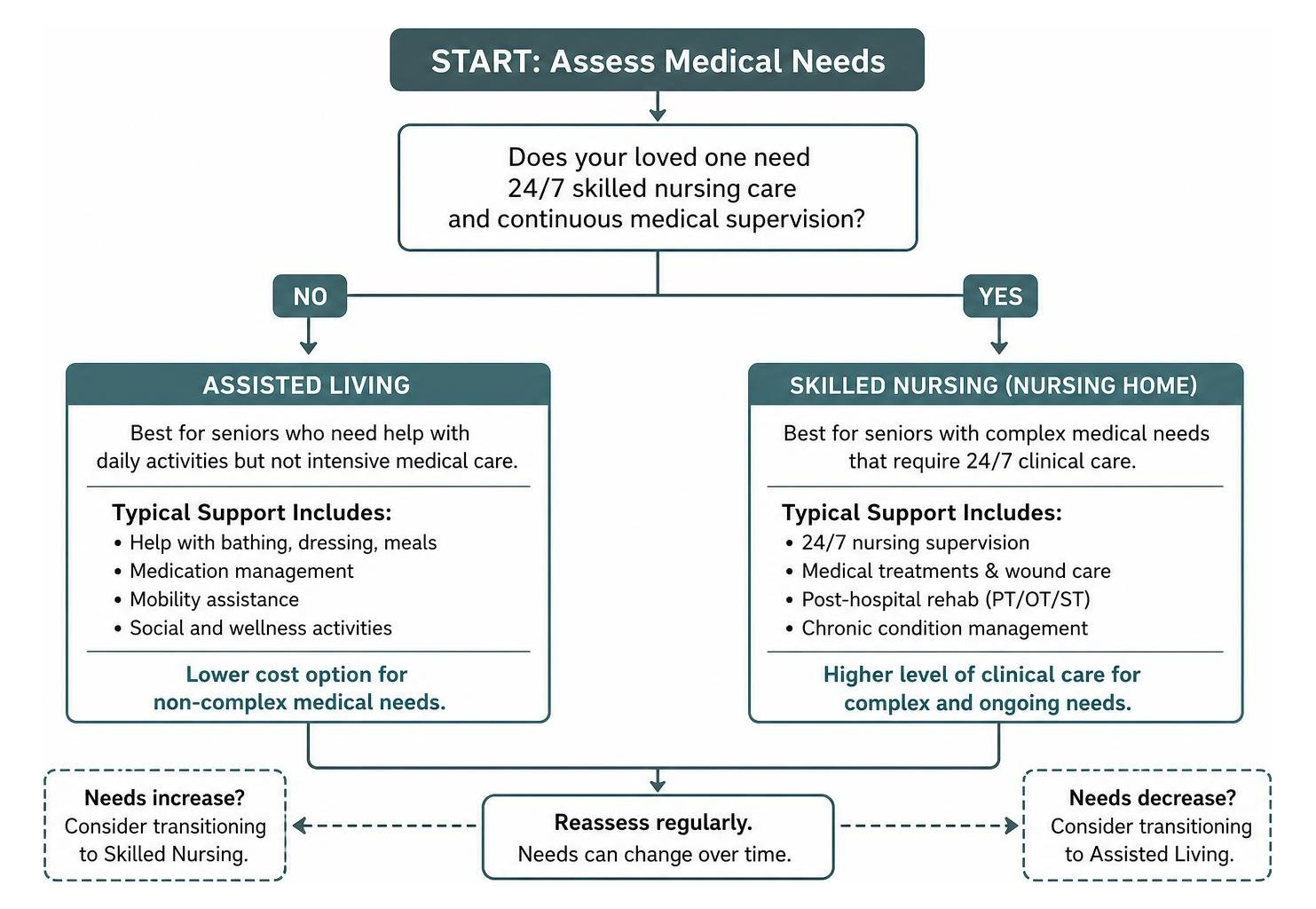
Understanding these distinctions prevents families from accidentally paying for a higher level of medical care than their loved one actually needs. To dive deeper into how these models differ, read our guide on Is Assisted Living the Same as a Nursing Home.
Nursing Homes vs. Assisted Living
A traditional nursing home provides skilled clinical care. This is the environment required for seniors who need round-the-clock supervision by registered nurses, daily wound care, ventilator support, or intense physical and occupational rehab after a major medical event. Because of the high staff-to-resident ratio and the constant presence of licensed medical professionals, the overhead is immense.
Assisted living, on the other hand, focuses on residential comfort and help with Activities of Daily Living (ADLs) — such as bathing, dressing, grooming, and managing medications. While there are trained caregivers on-site 24/7, the setting is residential rather than clinical. This difference in staffing is why assisted living is almost always the more budget-friendly route.
If your loved one is still mobile but struggles to cook balanced meals, remember to take their medications, or manage household chores, they likely do not need a nursing home. To evaluate which environment matches your current situation, check out our resource: Does My Mom Need Assisted Living or a Nursing Home.
Assisted Living as a Cost-Effective Alternative to Skilled Nursing
For seniors who do not require intensive, 24/7 clinical intervention, assisted living acts as an incredibly effective financial compromise. By choosing assisted living over a skilled nursing facility, families can often cut their monthly senior care bills by 40% to 50%.
In Idaho, regional pricing structures make this cost difference highly apparent. For instance, families researching options in the state will find that communities offering tailored personal care, like those highlighted in Assisted Living in Idaho Falls, ID, provide a vibrant, social lifestyle at a fraction of the cost of a clinical nursing room.
By utilizing assisted living when a senior only needs help with ADLs, you preserve their independence, keep them in a homelike environment, and protect the family’s financial resources for when higher medical needs might arise later in life.
Navigating the Realities of Affordable Nursing Homes
If a nursing home is medically necessary, finding one that fits a tight budget requires strategy. The truth is that private-pay rates for skilled nursing facilities are tied closely to regional economic factors. For example, states with lower minimum wages and lower costs of living generally have much lower private-pay rates than states like California, New Jersey, or Alaska.
While moving across state lines isn’t always practical, looking just outside of major metropolitan areas can yield significant savings. But what if private funds are already depleted? That is where understanding “Medicaid pending” status and specialized placement strategies becomes essential.
Many high-quality facilities allow residents to move in under a “Medicaid pending” status if their application for state long-term care benefits is underway. This prevents families from having to wait months for bureaucratic approval before securing a safe bed. To learn more about navigating these local searches, read our guide on Finding Quality Nursing Homes and Long-Term Care in Your Area.
How to Find Subsidized and Affordable Nursing Homes
To locate budget-friendly or subsidized nursing care in your area, focus your search on two primary targets:
- Medicaid-Certified Facilities: Since Medicaid is the primary payer for long-term clinical care in the United States, finding a facility with dedicated Medicaid beds is paramount.
- Non-Profit and County-Owned Homes: Non-profit senior communities are often structured to prioritize community service over profit margins. They may offer more flexible sliding-scale fees or have a higher ratio of Medicaid-approved beds.
You can begin your search by contacting your local Area Agency on Aging (AAA) or checking the state health department’s registry of licensed skilled nursing facilities. These registries outline which homes accept Medicaid and list their certification details.
Evaluating the Quality of Affordable Nursing Homes
A lower price tag should never mean a compromise on dignity and safety. When evaluating affordable nursing homes, look past the physical building and focus on federal quality metrics.
The Centers for Medicare & Medicaid Services (CMS) rates nursing homes on a scale of 1 to 5 stars based on three critical areas:
- Health Inspections: Historical records of deficiencies, safety violations, and infection control.
- Staffing: The actual number of hours registered nurses (RNs), licensed practical nurses (LPNs), and certified nursing assistants (CNAs) spend with each resident daily.
- Quality Measures: Clinical data regarding resident health outcomes, such as fall rates, pressure ulcers, and medication management.
Be particularly cautious of facilities with high nursing staff turnover rates (which can sometimes exceed 50% to 60% annually). High turnover often correlates with lower quality of care and understaffing. You can cross-reference these metrics using Medicare’s online Care Compare tool. For a step-by-step approach on how to parse this data, see our article on How to Choose Top-Rated Nursing Homes for Your Loved Ones.
Government Programs and Financial Assistance

When personal savings aren’t enough to cover senior care, government safety nets and benefit programs are designed to step in. However, qualifying for these programs requires careful navigation of strict financial and medical rules. To understand how medical necessity and financial aid intersect, read The Essential Guide to Long-Term Nursing Homes and Medical Care.
Medicaid Income and Asset Limits
Medicaid is a joint federal and state program, meaning the specific eligibility rules vary depending on where you live. For long-term nursing home care, applicants must meet both clinical criteria (proving a medical necessity for nursing-home-level care) and strict financial limits.
In most states, the financial thresholds are structured as follows:
- Asset Limits: A single applicant is typically limited to $2,000 or less in countable assets. Countable assets include savings accounts, stocks, bonds, and secondary real estate. Essential personal property, one vehicle, and the primary home (up to certain equity limits, if the spouse still resides there) are generally exempt.
- Income Limits: Monthly income limits vary by state, often capped around $2,982 per month (for 2026). If an individual’s income exceeds this limit but their medical bills are higher than their income, many states offer “spend-down” programs or Medically Needy pathways to help them qualify.
- The 5-Year Look-Back Period: To prevent people from simply giving away their money to qualify for Medicaid, states audit all financial transactions from the past 5 years (60 months). Any asset transfers or gifts made for less than fair market value during this window can trigger a penalty period, delaying when Medicaid will start paying for care.
Additionally, many states offer Home and Community-Based Services (HCBS) Medicaid waivers. These waivers allow eligible seniors to receive financial assistance for care in assisted living communities or in their own homes, helping them avoid moving into a clinical nursing home environment altogether.
Medicare, VA Benefits, and HUD Programs
While Medicaid is the heavy lifter for long-term clinical stays, other federal programs provide vital support for different scenarios:
- Medicare: A common point of confusion is assuming Medicare pays for long-term care. It does not. Medicare Part A only covers short-term rehabilitative stays in a skilled nursing facility (up to 100 days) following a qualifying 3-night inpatient hospital stay. Furthermore, starting on day 21, a high daily coinsurance rate applies out-of-pocket. To understand these limits fully, refer to Understanding Short-Term vs Long-Term Nursing Care Options.
- VA Aid and Attendance: Veterans and surviving spouses who require the active assistance of another person for daily activities may qualify for this tax-free pension expansion. This benefit can provide thousands of dollars a year to help pay for assisted living, home care, or nursing homes.
- HUD Section 202: The Department of Housing and Urban Development offers subsidized housing specifically for very low-income seniors. While Section 202 properties do not provide medical care, they drastically reduce housing expenses (capping rent at roughly 30% of the senior’s income), which frees up monthly funds to pay for private home health aides or future care.
Frequently Asked Questions about Senior Care Costs
Navigating senior care financial planning brings up many tough, urgent questions. Here are clear answers to the most common concerns families face.
Can a nursing home evict a resident for non-payment?
Yes, a nursing home can legally discharge or evict a resident for non-payment. However, they cannot simply put a resident out on the street. Under federal law, the facility must provide at least 30 days’ written notice. This notice must detail the exact reason for the discharge, the date it will take effect, the safe and appropriate location where the resident is being transferred, and instructions on how to appeal the decision.
Does Medicare pay for long-term nursing home stays?
No. Medicare is designed strictly for acute medical care and short-term rehabilitation. It will pay for 100% of the cost for the first 20 days of a skilled nursing stay (provided there was a prior 3-night hospital stay). From days 21 through 100, the resident must pay a daily coinsurance rate. Beyond 100 days, Medicare provides zero coverage for custodial or long-term nursing care.
What is the average monthly cost of a nursing home?
Nationally, the median cost of a semi-private room in a skilled nursing facility sits around $9,277 per month, while a private room averages $10,646 per month. These rates vary dramatically by region. In comparison, the median monthly cost of assisted living is $5,419, making it a much more accessible option for families who do not require intensive clinical care.
Conclusion
Finding affordable nursing homes requires patience, research, and a clear understanding of your loved one’s actual clinical needs. Far too often, families default to expensive nursing homes when a supportive, vibrant assisted living community would provide the perfect level of care at a fraction of the price.
At Arbor Village at Hillcrest in Boise, Idaho, we believe in providing high-quality, transparently priced senior living that honors your budget. Our renovated, pet-friendly community offers independent living, assisted living, and professional respite care designed to keep seniors active, social, and fully supported. With our attentive, highly praised staff and robust on-site activities, we help families find the perfect balance of care, comfort, and peace of mind.
If you are trying to determine the best path forward for your family, let us help.
Related Posts
- The Complete Guide to Assisted Living Benefits and Costs
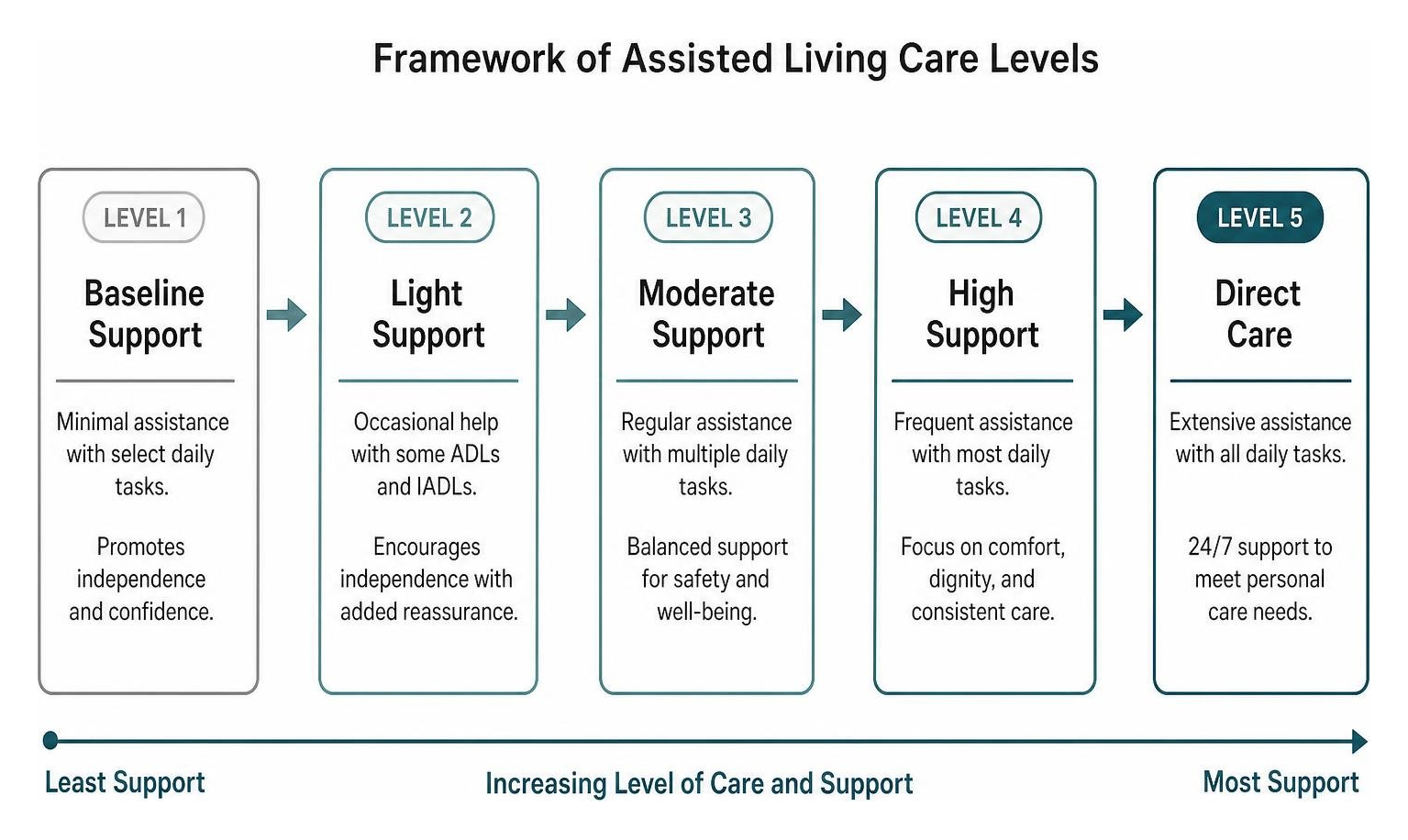
Discover the complete guide to assisted living benefits, costs, and care options to find the right community for your loved one.
- Assisted Living on the VA’s Dime: A Friendly Guide to Aid and Attendance

Assisted Living on the VA’s Dime: A Friendly Guide to Aid and Attendance – Learn about aid and attendance assisted living
- Thinking Outside the Piggy Bank: Creative Ways to Pay for Assisted Living

Discover creative ways to pay for assisted living using home equity, life insurance, VA benefits, and cost-saving strategies.
Recent Posts
 Top-Rated Skilled Nursing Facilities Near Boise and Meridian
Finding the Right Nursing Home Near Boise and Meridian
For families searching for a nursing home in Boise, start by matching your parent’s medical needs to the level of care offered. Look for 24-hour skilled nursing, therapy services, medication support, a safe setting, and clear information about staffing, inspections, costs, and current availability. Tour more than one community near Boise and Meridian, and ask how the team handles emergencies, chronic health conditions, and family communication.
Skilled nursing is often the right fit after a hospital stay or when a loved one needs ongoing medical oversight that assisted living cannot provide. In Boise, a semi-private nursing home room averages about $8,745 per month, so it is also important to discuss Medicare, Medicaid, long-term care insurance, and private-pay options early.
Idaho’s older-adult population continues to grow, making careful planning more important for Treasure Valley families. This guide highlights practical ways to compare skilled nursing facilities, verify quality records, and understand the path to admission.
I am Phillip King, a senior living executive with decades of experience in operations, resident experience, occupancy, and care planning across skilled nursing and other senior living settings. I bring a practical perspective to the nursing home Boise families need when care needs become more complex.
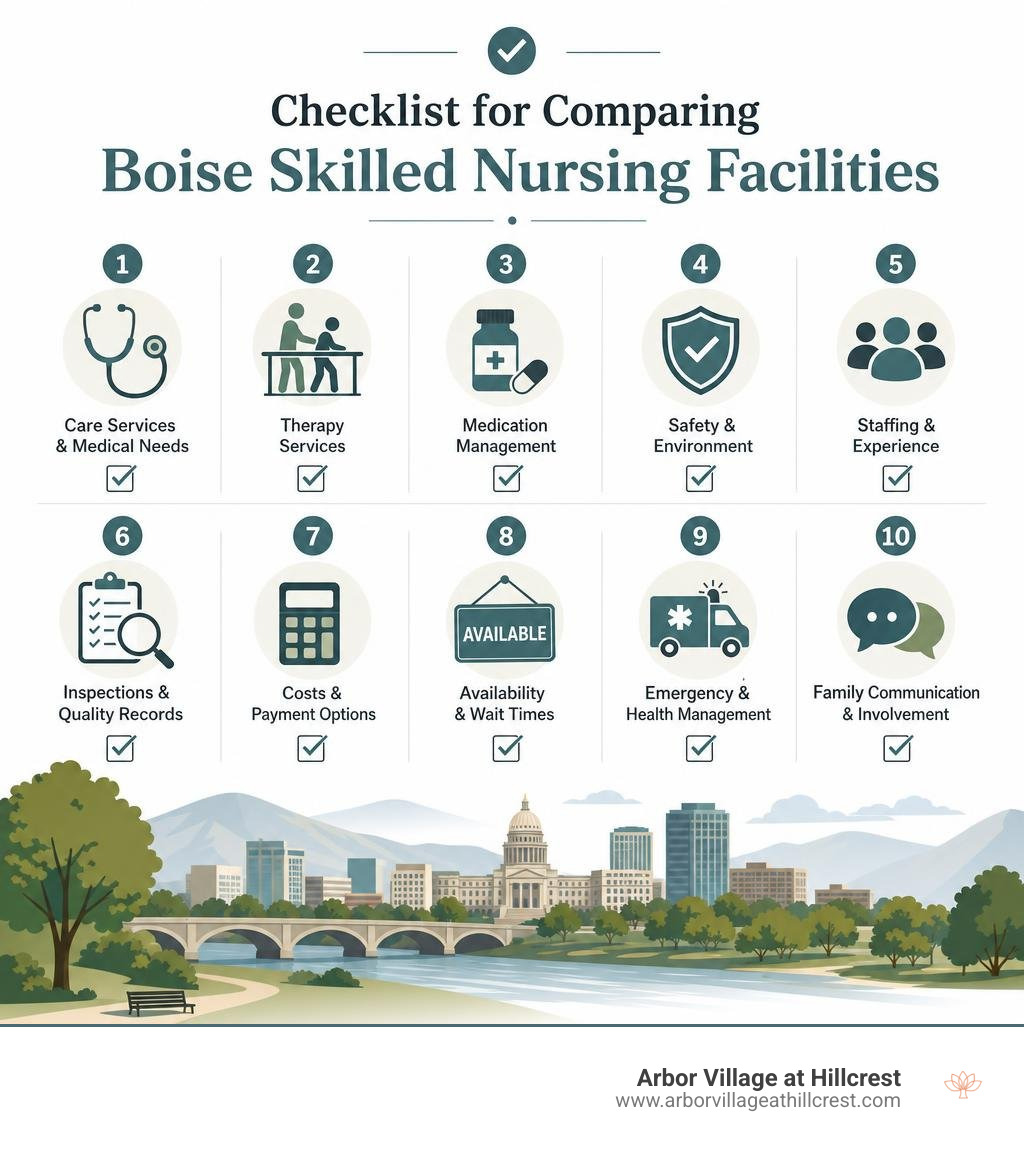
Nursing home boise terms at a glance:
- The Essential Guide to Long-Term Nursing Homes and Medical Care
- Navigating the Golden Years: Your Guide to Senior Nursing Homes
- Finding Quality Nursing Homes and Long-Term Care in Your Area
Key Factors When Choosing Skilled Care in the Treasure Valley
With nearly 15% of Idaho’s population aged 65 and older as of August 2026, the demand for high-quality senior care across the Boise metropolitan area has never been higher. When a loved one requires continuous medical attention, finding a trustworthy setting becomes an urgent priority. Evaluating clinical resources, staff engagement, and specialized programming will help your family make a well-informed decision.
Essential Care Levels and Staffing Ratios
Staffing ratios represent one of the most critical indicators of daily care quality in any skilled nursing environment. You want to ensure that registered nurses (RNs), licensed practical nurses (LPNs), and certified nursing assistants (CNAs) have manageable workloads so they can respond promptly to calls and provide individualized attention.
When touring communities, explore these key elements:
- Direct Care Hours: Ask how many hours of direct nursing care each resident receives per day. Higher direct care hours generally correlate with better clinical outcomes and fewer complications.
- 24-Hour Clinical Oversight: Verify that licensed nurses are on-site around the clock, not merely on call, to handle unexpected health changes.
- Consistency of Staffing: Ask about staff turnover. A consistent caregiving team gets to know your loved one’s baseline health, personality, and subtle changes in condition.
- Multidisciplinary Teams: Look for seamless collaboration between nursing staff, physical therapists, occupational therapists, dietitians, and social workers.
Understanding these operational layers can feel overwhelming, but exploring the essential guide to long-term nursing homes and medical care will help you ask the right questions during facility tours.
Medical Management and Specialized Clinical Services
A primary distinction of skilled nursing is the capacity to manage complex medical needs. Unlike standard residential senior living, skilled nursing teams handle advanced clinical treatments every day.
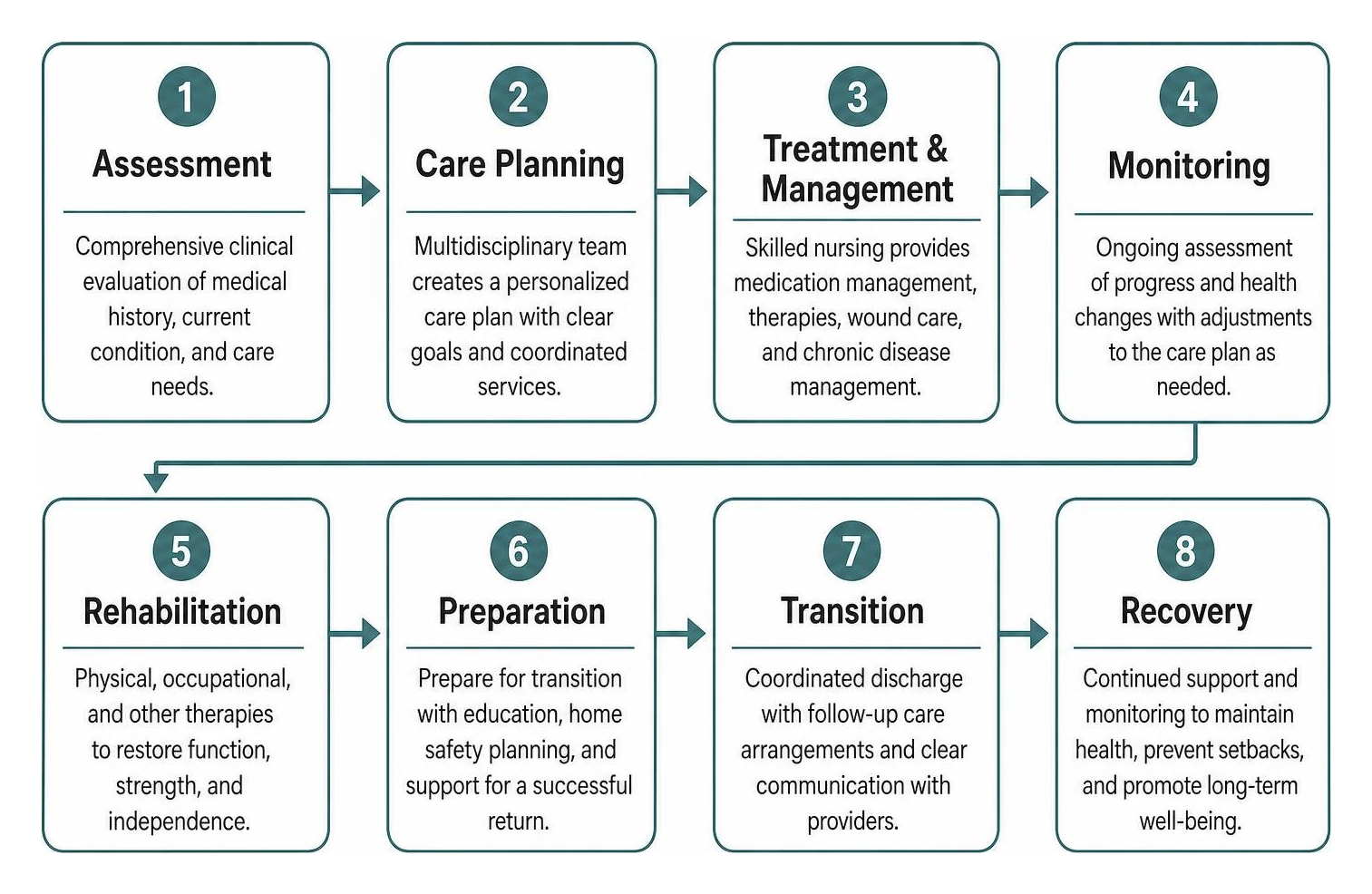
These medical services typically encompass:
- Chronic Disease Management: Coordinated care protocols for conditions such as congestive heart failure, COPD, Parkinson’s disease, and advanced diabetes.
- Medication Administration and Monitoring: Strict clinical oversight to manage multiple prescriptions, adjust dosages, and monitor for adverse drug interactions.
- Wound and Post-Surgical Care: Specialized treatment for non-healing surgical sites, pressure ulcers, and post-operative recovery.
- Emergency Coordination: Clear, rapid-response protocols with local emergency departments and regional medical centers.
For seniors recovering from acute medical events like a stroke or joint replacement, understanding understanding short-term vs long-term nursing care options ensures that rehabilitation goals align with family expectations.
Costs and Financial Planning for Treasure Valley Long-Term Care
Financing long-term care requires a clear understanding of what different living arrangements cost in the Treasure Valley. Because nursing homes offer round-the-clock medical care from licensed healthcare professionals, their operational costs are higher than standard senior living communities.
Comparing Costs: Nursing Home Boise Rates vs. Other Care Options
In the Boise area, the average monthly cost for a semi-private room in a skilled nursing facility sits at approximately $8,745. This is slightly below the national average of $9,034 per month, but it remains a substantial investment. By comparison, private rooms in skilled facilities often exceed $9,500 to $10,500 per month.
To put these rates in context, consider how skilled nursing compares with other senior housing models across southwest Idaho:
Care Type Primary Focus Average Monthly Cost (Boise Area) Payment Sources Skilled Nursing Facility 24/7 medical management, post-acute rehab, high-acuity care $8,745 (Semi-Private) Medicare (short-term), Medicaid, Long-Term Care Insurance, Private Pay Assisted Living Daily ADL support, meals, medication reminders, social life $4,500 – $5,800 Private Pay, Long-Term Care Insurance, Idaho Medicaid Waivers Independent Living Maintenance-free living, dining, social engagement, activities $2,800 – $4,000 Private Pay If your family is exploring budget-friendly ways to manage these expenses, the cost-conscious guide to affordable nursing homes offers practical strategies for optimizing personal savings, veteran benefits, and insurance policies.
Financial Assistance and Family Transition Resources
Few families can afford to pay out-of-pocket indefinitely for intensive skilled nursing. Fortunately, several assistance channels exist in Idaho:
- Idaho Medicaid: Administered by the Idaho Department of Health and Welfare (DHW), Medicaid covers long-term nursing home stays for individuals who meet both financial income/asset criteria and medical necessity standards.
- Medicare Part A: Covers up to 100 days of skilled nursing care following a qualifying three-day inpatient hospital stay (fully covered for days 1–20, with a daily co-pay for days 21–100), provided the resident continues to show measurable functional improvement.
- Veterans Benefits: The VA Aid and Attendance benefit provides monthly stipends to eligible veterans and surviving spouses to offset long-term care expenses.
- Area Agency on Aging (AAA): Local Treasure Valley counselors provide free advice to help families navigate benefit applications, community resources, and long-term care transitions.
Evaluating Quality and Safety in a Nursing Home Boise Families Trust
Entrusting a family member’s health to a long-term care facility requires diligence. Fortunately, state and federal regulatory frameworks offer objective data that allow you to assess the safety track record of any facility before signing an agreement.
State Health Inspections and Deficiency Records
In Idaho, nursing homes undergo rigorous unannounced surveys conducted by state health inspectors approximately once every 9 to 15 months. These surveys evaluate hundreds of safety, sanitation, clinical care, and resident rights standards.
- State Averages: Across Idaho, skilled nursing facilities average 3.8 health inspection deficiencies per facility.
- Deficiency Scope and Severity: Pay attention to whether citations were minor paperwork oversights or widespread care deficiencies that caused actual harm.
- Public Records: You can access survey reports directly through Medicare’s Care Compare portal or by requesting public inspection documentation from the Idaho Department of Health and Welfare.
Learning how to choose top-rated nursing homes for your loved ones gives you a reliable framework for reading these inspection reports like an industry insider.
Facility Amenities, Culture, and Social Engagement
While clinical competency is vital, a resident’s emotional well-being depends heavily on daily community life. Even in medical settings, a vibrant environment promotes faster healing and higher quality of life.
Look for facilities that provide:
- Individualized Activity Programs: Meaningful daily calendars including music therapy, gentle movement classes, art sessions, and cognitive games.
- Nutritious, Chef-Prepared Meals: Menus that accommodate dietary restrictions (such as diabetic, renal, or pureed diets) without sacrificing flavor.
- Comfortable Common Spaces: Bright living rooms, secure outdoor courtyards, and dedicated physical therapy gyms.
- Family Inclusion: Open visiting hours, private family gathering areas, and responsive communication channels with charge nurses.
Admissions Process and Finding Availability Near Meridian
Moving into a skilled nursing home involves specific legal, medical, and administrative milestones. Preparing these documents ahead of time prevents stressful delays, especially during hospital discharge transitions.
Navigating Admissions and Waitlists for a Nursing Home Boise Location
Idaho nursing homes maintain an average occupancy rate of 70.2%. While this indicates that beds are generally available statewide, top-rated facilities in the high-growth Boise-Meridian corridor often experience waiting lists for private suites or specific specialized wings.
To keep the admissions process moving smoothly:
- Obtain Physician Orders: A medical doctor must certify that the individual requires skilled nursing level of care.
- Complete the PASRR Screen: Federal law requires a Preadmission Screening and Resident Review (PASRR) to assess for mental illness or intellectual disabilities before admission.
- Assemble Financial Records: Gather bank statements, insurance cards, power of attorney documents, and advance directives.
- Conduct an On-Site Assessment: The facility’s clinical liaison or Director of Nursing will evaluate the applicant’s medical chart to confirm they can meet all clinical needs.
For families comparing regional options across Ada and Canyon counties, finding great nursing homes in Boise, Meridian, and beyond offers additional insights into local regional capacity.
Determining the Right Level of Care
A central challenge for families is determining whether a loved one genuinely requires a skilled nursing facility or if their needs would be better served in an assisted living community.
Assisted living is ideal for older adults who need help with Activities of Daily Living (ADLs)—such as bathing, dressing, grooming, and meal preparation—but do not require constant, complex medical intervention. At Arbor Village at Hillcrest, our renovated, pet-friendly community in Boise provides personalized assisted living, independent living, and temporary respite care. Our attentive staff creates a warm, social environment with rich daily activities, allowing residents to maintain their independence with just the right amount of daily support.
If you are unsure where your family member falls on the care spectrum, reading is assisted living the same as a nursing home? will clarify the core medical differences between these models.
Frequently Asked Questions About Boise Skilled Nursing Care
What is the average monthly cost of skilled nursing in Boise?
In Boise, a semi-private room in a skilled nursing facility costs an average of $8,745 per month. Private rooms typically cost more, often ranging from $9,500 to $10,500 per month depending on the facility’s location, amenities, and specialized clinical offerings.
How do I review the safety and health records of Idaho facilities?
You can review safety records and inspection results using the federal Medicare Care Compare website, which rates facilities from 1 to 5 stars on health inspections, staffing hours, and quality measures. You can also request state survey reports from the Idaho Department of Health and Welfare Division of Licensing and Certification. Idaho facilities average 3.8 deficiencies per survey.
What clinical criteria are required for nursing home admission in Idaho?
Admission requires a formal medical assessment and physician’s order certifying that the patient needs skilled nursing or rehabilitative services on a daily basis. This includes needs like complex wound care, intravenous therapy, feeding tube management, severe mobility deficits requiring two-person transfers, or comprehensive post-operative physical rehabilitation. A PASRR screening is also required by law.
Conclusion
Finding the ideal care setting for an aging family member requires balancing clinical capabilities, financial considerations, and personal dignity. By reviewing state inspection records, understanding local costs, and touring facilities firsthand, you can secure compassionate care that brings your family lasting peace of mind.
If your loved one requires support with daily personal care, medication management, and an engaging social lifestyle rather than round-the-clock clinical medical treatment, a warm assisted living community may be the perfect fit. We invite you to explore does my mom need assisted living or a nursing home? to evaluate your family’s next steps and discover how our attentive team at Arbor Village at Hillcrest can support your journey.
 Why Moving to Boise Idaho Delivers the Perfect Lifestyle Upgrade
Boise, Idaho Niche: A Strong Lifestyle Match With Important Trade-Offs
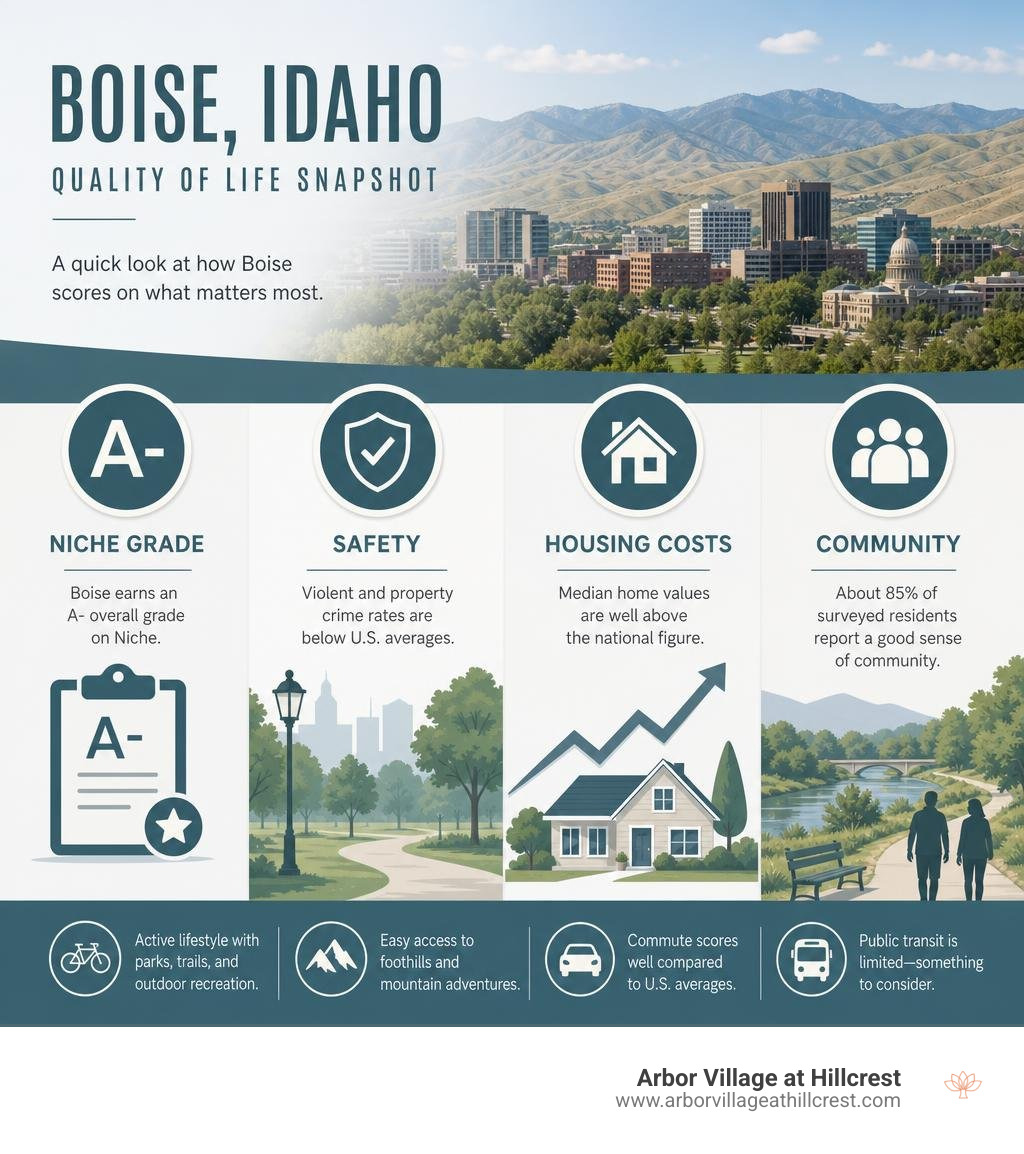
Boise earns an A- overall grade on Niche, making it a strong choice for older adults and families who value safety, community, health, and easy access to the outdoors. The city ranks #12 among the Best Places to Live in Idaho, while its public schools, outdoor activities, health and fitness options, and commute receive especially strong marks.
For adult children helping a parent consider a move, Boise’s appeal is clear:
- Safer-than-average: Violent and property crime rates are below U.S. averages.
- Active lifestyle: The Boise River Greenbelt, foothill trails, parks, and nearby mountain recreation support everyday movement.
- Connected community: About 85% of surveyed residents report a good sense of community.
- Housing pressure: Median home values are well above the national figure, so affordability deserves close attention.
Boise offers a useful blend of city services and a calmer, more residential feel. Still, rapid growth has brought higher housing costs, more traffic, and limited public transit – practical issues to weigh when choosing a neighborhood or senior living setting.
I am Phillip King, an executive leader with decades of experience across senior living operations, occupancy, resident experience, and financial performance. In reviewing Boise Idaho Niche data, I focus on what quality-of-life scores mean in real terms for older adults and the families supporting them.
Boise idaho niche vocab to learn:
What the Boise Idaho Niche Report Card Reveals About Quality of Life
When you look at the broad spectrum of data compiled by Boise, ID – Niche, the picture that emerges is one of balanced, active livability. Boise provides a dense suburban feel across Ada County, blending clean municipal infrastructure with immediate connections to the scenic beauty of southwestern Idaho.
The city scores exceptionally well in core daily living categories. It earns straight A ratings in Outdoor Activities, Health & Fitness, and Commute, backed by an A- in Public Schools. These scores reflect a municipality designed around personal wellness and outdoor mobility. Whether you are walking along tree-lined boulevards, commuting downtown in under 20 minutes, or cycling along riverside pathways, the physical environment encourages an active, healthy routine.
However, the report card also highlights areas that require careful planning. Boise receives a C+ in Housing and a C- in Cost of Living. The influx of new residents over the past decade has pushed home values higher, meaning prospective movers must balance Boise’s undeniable lifestyle perks against current real estate dynamics.
Evaluating the Boise Idaho Niche Livability Scores and National Rankings
National recognition for Idaho’s capital continues to climb. According to the 2026 Boise, ID Rankings – Niche, the city holds impressive standings across competitive national and statewide benchmarks:
- #12 in Best Places to Live in Idaho
- #51 of 229 in Cities with the Best Public Schools in America
- #53 of 230 in Healthiest Places to Live in America
- #80 of 229 in Best Cities to Live in America
- #18 of 69 in Best Places to Retire in Idaho
- #85 of 229 in Best Cities to Retire in America
Beyond the competitive numerical standings, resident sentiment remains overwhelmingly positive. In community surveys, 85% of residents report a strong sense of community, with 54% to 56% characterizing their neighbors as genuinely friendly. This welcoming social fabric is a primary reason why families and seniors choose to establish long-term roots here.
Public Safety and Crime Statistics
Safety is often the primary concern when evaluating a relocation for yourself or an aging parent. Boise stands out nationally as a secure metropolitan area, with crime figures well below United States benchmarks across nearly every metric tracked by the FBI and local law enforcement.

The table below illustrates how Boise’s annual crime rates per 100,000 residents compare against national averages:
Crime Category Boise Rate (per 100,000) National Average (per 100,000) Assault 177.7 282.7 Murder 2.1 6.1 Robbery 21.9 135.5 Burglary 131.7 500.1 Theft 971.9 2,042.8 Motor Vehicle Theft 138.8 284.0 Visible community policing, active neighborhood associations, and well-maintained public parks contribute to theft and burglary rates that are less than half the national standard. This high baseline of safety provides incredible peace of mind for evening walks, downtown dining, and independent living.
Real Estate Market and Cost of Living in Boise
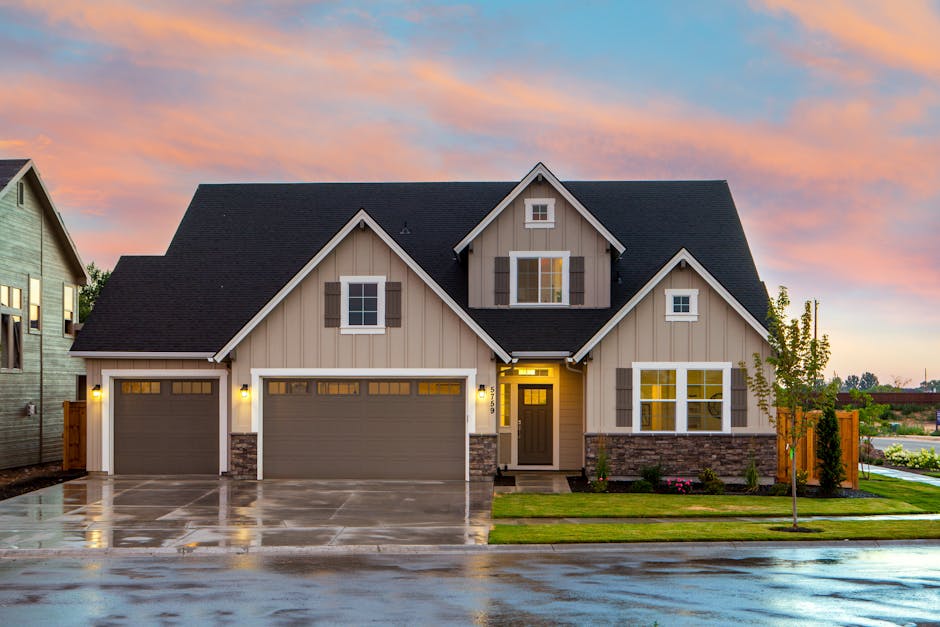
Understanding the local property landscape is essential for anyone considering a move. Boise’s real estate market has matured rapidly from an overlooked regional pocket into a competitive housing market. Before finalizing plans, reviewing An Essential Guide to Boise ID Key Information Insights helps establish a baseline for navigating the area’s practical daily costs.
The city maintains a 63% homeownership rate, with 37% of the population renting. The median home value currently stands at $456,000 (with newer district averages reaching between $484,800 and $493,319), compared to the national median of $303,400 to $332,700. For renters, the median monthly rent ranges from $1,359 to $1,446, aligning closely with the national median of $1,348 to $1,413.
Housing Trends and Neighborhood Affordability
A closer look at the Boise Real Estate Market – Niche shows that property values are concentrated in mid-to-upper price brackets.
- $400,000 – $749,000: 52% of homes
- $200,000 – $399,000: 23% of homes
- $750,000 and above: 18% of homes
- Under $200,000: 7% of homes
Despite elevated purchase prices relative to national baselines, resident polls reveal that 53% of local residents still consider Boise housing affordable relative to regional wages and quality of life. Furthermore, 70% of residents rate the interior and exterior quality of Boise homes as good or excellent, reflecting high construction standards, established tree canopies, and well-kept suburban properties.
Demographic Profile and Economic Strength
Boise’s local economy provides a stable foundation for working professionals and retirees alike. According to Boise Demographics and Statistics – Niche, the city is home to a population of approximately 235,701 to 237,242 residents.
The local economy boasts an exceptionally low unemployment rate of 2.5% to 2.6% and a poverty rate of 10.6%. The median household income sits at $81,308 to $83,904, comfortably outperforming the national median of $78,538 to $80,734.
Educational attainment across the city is high:
- 30% hold a Bachelor’s degree
- 18% hold a Master’s degree or higher
- 28% have completed some college or earned an Associate’s degree
Boise also features an established senior demographic, with 15% to 16% of the population aged 65 and older. This creates a vibrant intergenerational community where older adults enjoy dedicated wellness programs, active community centers, and specialized healthcare networks.
Top-Rated Neighborhoods and Education Options in the Treasure Valley
Finding the right part of town depends on whether you value historic architecture, foothill trail access, or proximity to local dining. To pinpoint specific locations across Ada County, explore our breakdown of Boise Zip Codes Find Your Way Around Idahos Capital.
Several standout neighborhoods define the Boise experience:
- North End (Grade A+): Known for historic Craftsman bungalows, the vibrant Hyde Park retail strip, and immediate access to the Boise Foothills trail system.
- Boise Heights (Grade A): Elevated living featuring panoramic views of the Treasure Valley, large lot sizes, and quiet residential streets.
- Sunset (Grade A): A charming, family-friendly pocket offering convenient access to local parks, downtown, and Veterans Memorial Parkway.
- Depot Branch (Grade A-): Centered around the historic Boise Depot, this neighborhood earns an A+ in Nightlife and A in Outdoor Activities, ranking #5 among Best Neighborhoods for Young Professionals in Boise. It boasts a median home value of $446,701 and a 67% homeownership rate.
Navigating Neighborhood Profiles Using Boise Idaho Niche Insights
Neighborhood grading on Niche takes into account everyday livability factors such as walkability, park access, crime frequency, and local commute times.
While neighborhoods like North End and Depot Branch offer walkable access to coffee shops, local bistros, and urban parks, outer suburban neighborhoods deliver larger floor plans, newer construction, and quiet cul-de-sacs. Whether evaluating an area for a young family or a senior looking to downsize near medical providers, the diversity of Boise’s micro-neighborhoods accommodates a wide range of lifestyle priorities.
Public, Charter, and Private School Excellence
The region is widely recognized for its robust educational ecosystem. The Boise School District – Idaho – Niche holds an overall grade of A-, serving over 22,000 students with a favorable 16:1 student-teacher ratio, an 83% graduation rate, and an average SAT score of 1210.
Key educational benchmarks include:
- Top Elementary Schools: Ada County’s top public elementary performers include Collister Elementary School, Highlands Elementary, and Roosevelt Elementary—with half of the county’s top 10 elementary schools located within Boise.
- Top Public High Schools: Renaissance High School (Grade A+), Meridian Medical Arts Charter School (Grade A+), and Boise Senior High School (Grade A) lead regional academic rankings.
- Charter Leadership: North Star Charter School holds an overall A grade (A+ for Teachers), ranking as the top K-12 public charter institution in Ada County.
- Premier Private Options: Riverstone International School ranks as the #1 private school in Boise (Grade A+). Situated on a 14-acre campus, it offers an International Baccalaureate (IB) curriculum from preschool through 12th grade, where 100% of graduates gain acceptance to top four-year colleges.
Weighing the Pros and Cons of Relocating to Boise
Examining resident feedback on Boise, ID Reviews – Niche (where the city maintains a stellar 4.4 out of 5-star rating across nearly 700 reviews) reveals clear lifestyle advantages alongside practical growth considerations.
Key Lifestyle Advantages
- Four-Season Outdoor Recreation: Residents enjoy floating the Boise River in the summer, hiking the Ridge to Rivers foothill trail system in the spring and fall, and skiing at Bogus Basin Mountain Recreation Area just 23 miles from downtown during the winter.
- The Boise River Greenbelt: A 25-mile paved pathway weaving through the heart of the city, connecting scenic riverside parks, Boise State University, and downtown dining.
- Vibrant Cultural & Culinary Scene: Boise features thriving craft breweries, local farm-to-table dining, the Basque Block, and community venues like JUMP (Jack’s Urban Meeting Place).
- Collegiate Spirit: The community gathers around Boise State Broncos athletics, famously cheering on the blue turf at Albertsons Stadium.
- Welcoming Atmosphere: Newcomers regularly note the clean public spaces, well-maintained parks, and neighborly culture.
Growth Challenges and Relocation Considerations
- Housing Cost Pressures: Home values have risen significantly, requiring careful budgeting for buyers moving from lower-cost regions.
- Transit Limitations: Public transportation options like Valley Regional Transit buses are limited, making personal vehicle ownership standard for daily commuting.
- Traffic Congestion: Influx across Ada County has extended commute times along major arterial routes like Interstate 84 and Eagle Road during peak hours.
- Administrative Adjustments: If you are managing relocation paperwork, address changes, or legal filings, refer to The Quick Guide to Writing the Boise Idaho Abbreviation Correctly to ensure smooth processing across municipal and postal forms.
Frequently Asked Questions About Living in Boise
What is the overall Niche grade for Boise, Idaho?
Boise holds an overall Niche grade of A-. The city earns standout A grades in Outdoor Activities, Health & Fitness, and Commute times, an A- in Public Schools, balanced against lower grades in Housing (C+) and Cost of Living (C-). It ranks #12 among the Best Places to Live in Idaho and #53 in Healthiest Places to Live in America.
Is Boise, Idaho a safe place to live and raise a family?
Yes, Boise is statistically safer than most U.S. cities of comparable size. Its violent crime rate for assault (177.7 per 100k) is significantly lower than the national average (282.7 per 100k), and its theft rate (971.9 per 100k) is less than half the national benchmark (2,042.8 per 100k).
How does the cost of living in Boise compare to the national average?
Boise’s cost of living is slightly higher than the national baseline, primarily driven by real estate. The median home value in Boise is approximately $456,000 (compared to the $303,400 national median). However, median rental rates ($1,359 to $1,446) track closely with national figures, and median household incomes ($81,308 to $83,904) remain higher than national averages.
Conclusion
Boise, Idaho delivers a compelling lifestyle upgrade that balances outdoor recreation, clean neighborhoods, high-performing schools, and low crime rates. While the cost of housing has increased alongside the city’s popularity, the strong sense of community, thriving economy, and active four-season environment make it an exceptional destination for families, working professionals, and seniors alike.
At Arbor Village at Hillcrest, we understand how important finding the right community is when planning a lifestyle transition. Our beautifully renovated, pet-friendly senior living community provides independent living, supportive assisted living in Boise Idaho, and respite care. With robust daily activities, attentive staff, and on-site amenities, we make it easy for older adults to experience the very best quality of life Idaho’s capital has to offer.
 Hit the Road with the Best Senior Day Trips Near Boise
Scenic and Low-Impact Outdoor Activities for Seniors
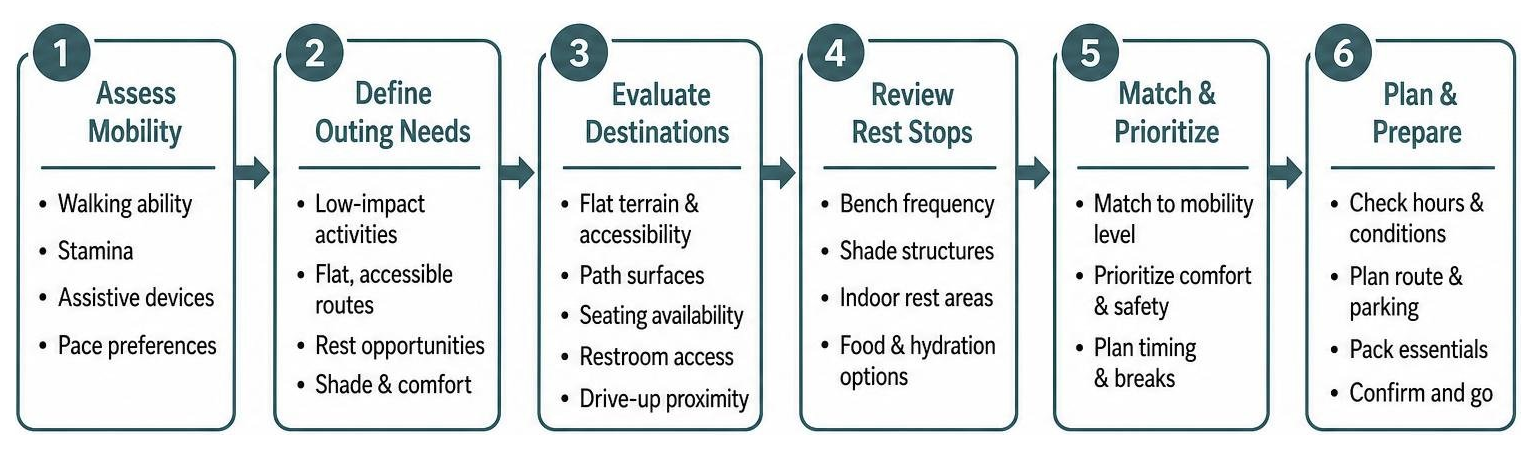
When planning outdoor excursions for older adults, finding destinations that offer natural beauty without requiring strenuous physical exertion is essential. The Treasure Valley is packed with scenic spots designed for visitors who prefer a relaxed pace, flat terrain, and frequent rest areas.
Idaho Botanical Garden
Located right next to the historic Old Idaho Penitentiary, the Idaho Botanical Garden offers beautifully manicured displays with gentle, easy-to-navigate paths. Seniors can stroll through native Idaho flora, rose gardens, and shade structures at their leisure. Benches are generously placed throughout the grounds, providing continuous opportunities to sit, catch your breath, and take in the view.
Zoo Boise and Julia Davis Park
Situated within Julia Davis Park, Zoo Boise features a compact footprint. Unlike massive regional zoos that require miles of walking, Zoo Boise is manageable in size, making it large enough to feel like an adventure while remaining accessible for older adults. After visiting the animals, taking a short stroll along the Boise River Greenbelt section near the park offers flat, paved surfaces with views of ducks, trees, and the river.
Eagle Island State Park
For a tranquil picnic outing, Treasure Valley Outings at Eagle Island State Park offer smooth, level walking paths and vast open spaces. It requires no major physical commitment—you can park close to covered shelters, set up a comfortable camp chair, and enjoy a peaceful afternoon by the water.
Bogus Basin
If you want breathtaking mountain scenery without any hiking, take the drive up to Bogus Basin. During the summer months, seniors can ride the scenic chairlift to enjoy sweeping views of the surrounding ranges and cooler mountain temperatures. It is an ideal outing for enjoying Idaho’s high country entirely at your own comfort level.
Cultural, Historic, and Culinary Senior Living Day Trips Boise Area
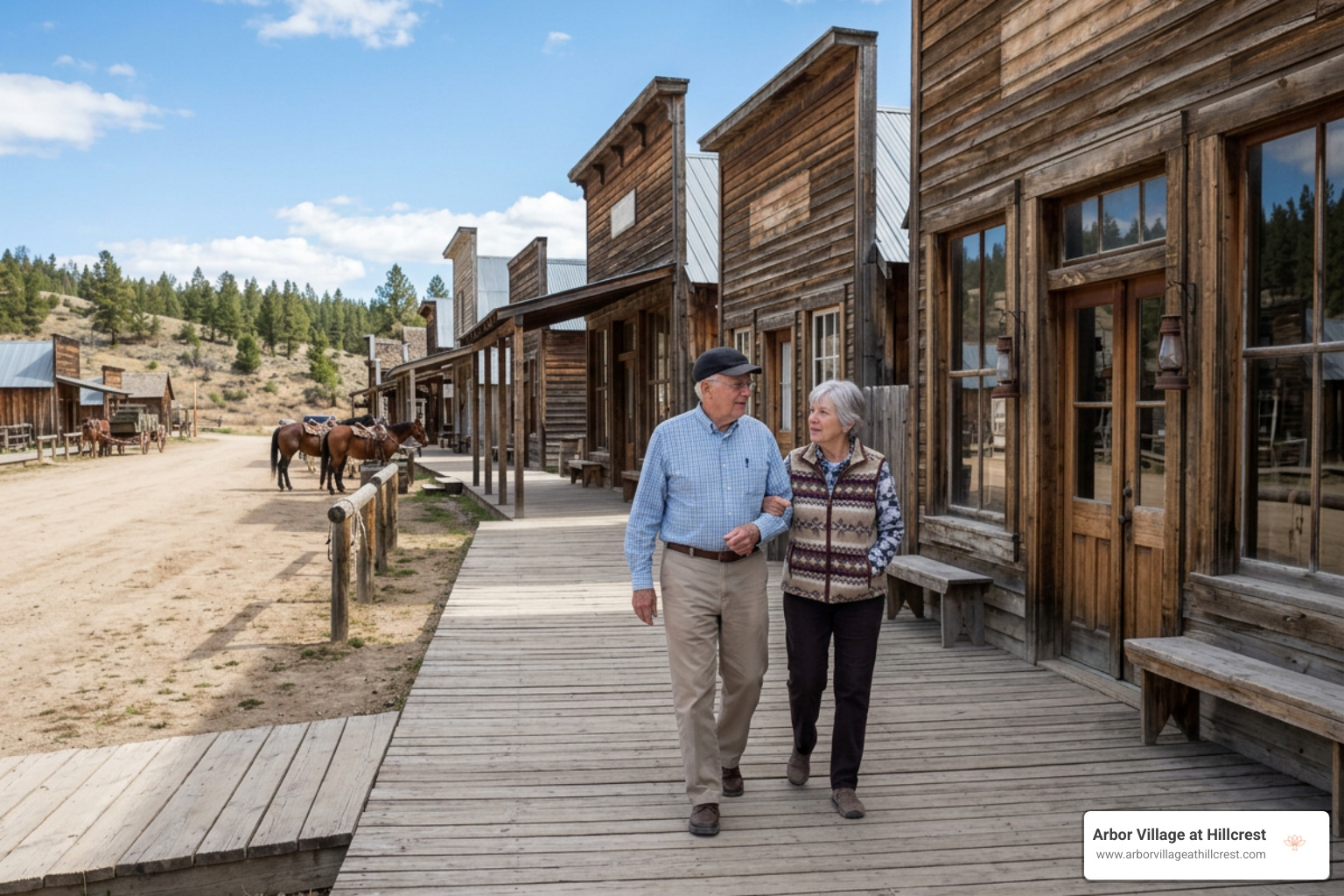
For seniors who prefer learning about local heritage or sampling region-specific dishes, the Boise region provides several rich cultural and culinary day trips requiring minimal physical exertion.
Idaho City Historic District
Take a step back into Idaho’s gold rush history with a visit to Idaho City, located just an hour northeast of Boise. The Idaho City Historic District Walking Tour is a relaxed, 1-hour experience that covers local history along flat boardwalks and historic sites. At just $7 per ticket, it offers an affordable and highly engaging window into the 1860s.
Local Food Walks and Farmer’s Markets
If culinary exploration is on the menu, downtown Boise offers several structured, low-impact walking tours focused on food and beverage:
- BoDo Savor & Sip Foodie Walk: A 2- to 3-hour guided stroll through downtown’s BoDo district, featuring small-plate tastings with short walks between stops.
- Boise River Urban Wine Walk: A relaxed sip-and-stroll tour visiting urban tasting rooms along flat, paved downtown streets.
- Boise Farmers’ Market: Held on Saturdays, this market provides a vibrant, low-key environment where seniors can sample fresh local baked goods, fruits, and artisanal crafts without long walking distances.
Many of these guided cultural and foodie walks can be booked via specialized operators like Cool Destinations, offering structured schedules and modest physical demands. For more regional travel ideas, explore these Senior Idaho Activities.
Weather-Friendly Indoor Destinations in the Treasure Valley

When summer heat climbs or winter air settles into the valley, having reliable, climate-controlled indoor destinations ensures outings do not have to be canceled.
Discovery Center of Idaho
Located near Julia Davis Park, the Discovery Center of Idaho is an outstanding indoor destination. Featuring interactive, hands-on exhibits focused on science, technology, engineering, and art, it offers flat floor plans, comfortable seating, and wide pathways that easily accommodate wheelchairs and walkers. It is equally engaging for independent seniors and visiting grandchildren.
The Village at Meridian
For a multi-faceted outing, The Village at Meridian combines indoor and outdoor amenities seamlessly. Older adults can watch the synchronized fountain shows from shaded outdoor benches, or head inside for dining and entertainment. Venues like Big Al’s offer accessible indoor bowling, arcade games, and comfortable restaurant seating. The Village also features clean, easily accessible restrooms and ample designated handicap parking close to main store entrances.
For more structured indoor activities and community outings, check out local municipal resources like the City of Boise Leisure Programs.
Guided Tours, Senior Discounts, and Smart Excursion Planning
To help you compare the top senior living day trips Boise options at a glance, we have summarized key details below:
Destination / Tour Ideal Mobility Level Average Duration Key Accessibility Features Idaho Botanical Garden Easy to Moderate 1.5 – 2 Hours Flat paved/gravel paths, frequent benches, shade Zoo Boise & Greenbelt Easy 2 Hours Fully paved, level walking, wheelchair rentals Shoshone Falls Guided Tour Easy (Transport Provided) 4 Hours (Half-Day) Hotel pickup, scenic viewing platforms, minimal walking Idaho City Historic Tour Moderate 1 Hour Boardwalks, low cost ($7), historical guide Discovery Center of Idaho Easy 1.5 – 2 Hours Fully indoor, ADA accessible, climate controlled The Village at Meridian Easy Flexible (1–3 Hours) Paved plaza, extensive seating, accessible restrooms 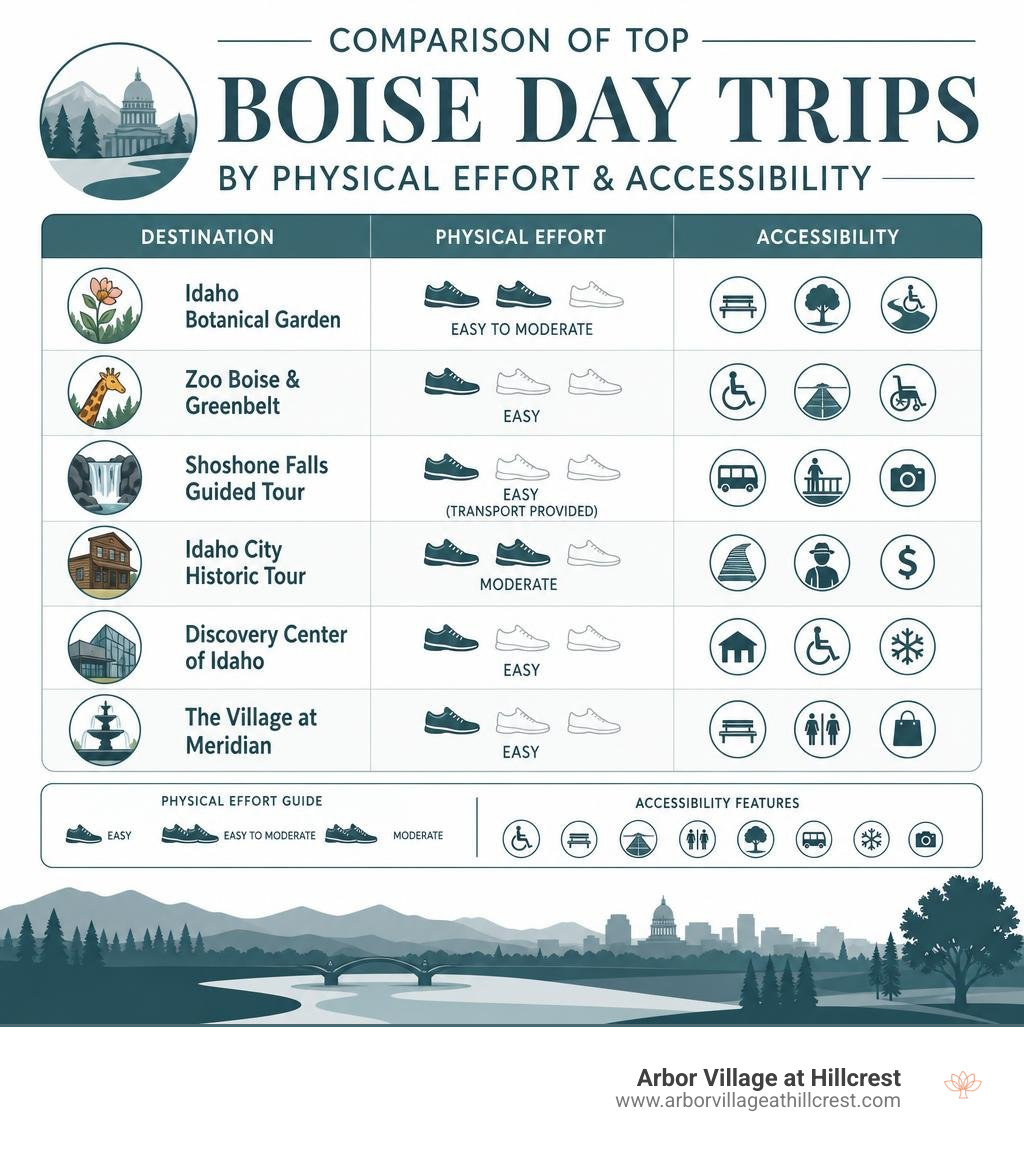
Saving Money with the WISDOM Promo Code
When reserving guided excursions through booking portals such as Cool Destinations, older adults can take advantage of practical savings. Using the promo code WISDOM grants a 10% discount on various Idaho tours and experiences.
For example, the Guided Half-Day Tour to Shoshone Falls & City Tour is a popular 4-hour option that incorporates a city overview with a scenic visit to the “Niagara of the West.” This guided excursion offers direct hotel pickup, flexible scheduling, and free cancellation policies—taking the stress out of navigation and parking while saving money.
Multi-Generational Senior Living Day Trips Boise Families Recommend
When planning an outing that involves multiple generations—such as grandparents, adult children, and grandchildren—the key to success lies in choosing balanced locations:
- Pacing: Keep active walking segments under 45 minutes before scheduling a sit-down break.
- Snacks & Hydration: Bring water and simple snacks to maintain energy levels between meals.
- Restroom Proximity: Pick locations like Julia Davis Park or The Village at Meridian where clean facilities are never far away.
- Visual Memories: Bring a camera or smartphone to capture group moments against scenic backdrops. Take a look at our community gallery to see how our residents enjoy social outings together, or read our senior lifestyle blog for more localized event tips.
Relaxed Senior Living Day Trips Boise Transportation and Comfort Tips
Executing a smooth day trip comes down to practical preparation:
- Vehicle Accessibility: Ensure the travel vehicle has comfortable seating heights and enough trunk space for folding walkers or wheelchairs.
- Parking: Look up parking options beforehand; choosing venues with dedicated handicap spaces close to the main entrance prevents fatigue before the activity even starts.
- Weather Dressing: Boise weather can shift quickly, especially between morning and afternoon. Layering clothing and bringing wide-brimmed hats and sun protection makes outdoor strolls much more comfortable.
Frequently Asked Questions About Senior Day Trips Near Boise
What are the best outdoor day trips near Boise for seniors with limited mobility?
The best options include the paved river paths along the Boise Greenbelt at Julia Davis Park, the scenic chairlift rides at Bogus Basin, and the flat, bench-lined garden walks at the Idaho Botanical Garden.
How can older adults get discounts on guided tours around Boise?
Seniors can use the promo code WISDOM on Cool Destinations to receive 10% off guided tours across Idaho, including popular excursions like the half-day Shoshone Falls guided trip.
Which Boise attractions offer indoor options during poor weather?
Top indoor options include the Discovery Center of Idaho for hands-on, climate-controlled exhibits, and The Village at Meridian, which features indoor dining, shopping, and entertainment like Big Al’s.
Conclusion
Exploring the Treasure Valley should be an exciting, fulfilling experience for older adults, not an exhausting chore. By selecting locations tailored to comfortable pacing, clear walkways, and accessible amenities, seniors can continue discovering everything our vibrant region has to offer.
At Arbor Village at Hillcrest, we are passionate about keeping life engaging, social, and vibrant for our residents. From group excursions to vibrant on-site activities, our team ensures every individual receives attentive care while enjoying an active lifestyle. To learn more about our supportive environment, explore our senior living services, check our upcoming community events, or contact us today to tour our senior living community.


Ready to take the next step?
Schedule a Tour